Loading
Loading games and devlog…
Loading games and devlog…
Sometimes, the biggest breakthrough comes from realizing you don't have to do everything yourself.
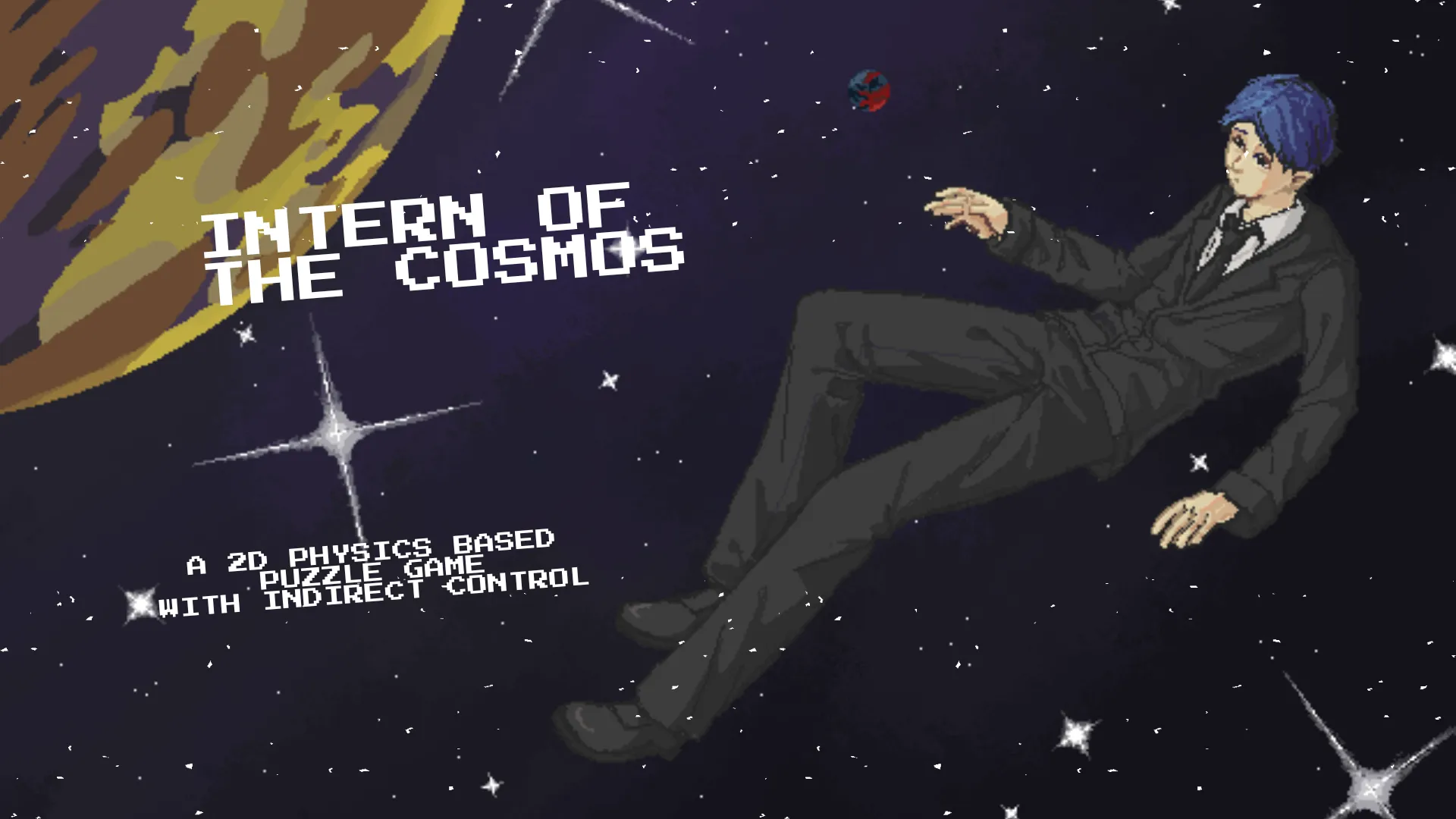
Intern of the Cosmos is a physics-based puzzle game where you don't directly control the main character. Instead, you manipulate gravity, place cosmic objects, and reshape the environment to guide a helpless human toward a dimensional portal.
Every object has its own gravitational properties. Every placement can change the character's trajectory. And with hostile spacecraft, dangerous obstacles, and increasingly complicated environments, even a small mistake can send your human drifting into the endless void.
The concept is simple: you don't control the human. You control the universe around them.
Developed for GDGoC UNSRI Game Jam 26, Intern of the Cosmos became much more than another game jam project. It was a turning point in how I approached programming, game design, and even my own confidence as a developer.
After two consecutive disappointing project experiences, I entered this jam carrying quite a bit of impostor syndrome.
I still remember a conversation during the event:
"Nice to meet you! Are you a pro?"
"No."
"Honestly, I'm a newbie. Could you tell me how many jams you've joined before?"
"Six."
"... -_-"
Despite having participated in several jams already, I didn't exactly feel like someone who knew what they were doing.
I decided to play it safe. Instead of attempting another ambitious project, I went with a relatively small puzzle game with a manageable scope.
There was also a technical reason behind that decision. Since the other programmers weren't familiar with Unity, I returned to Godot, the engine I had previously used for Walking Bomb.
It felt like going back to familiar territory, but this time, I approached the project with a different mindset.
One of the biggest lessons I learned during this project was surprisingly simple:
Code less, do more.
I used to think that building complex gameplay required writing increasingly complex scripts. Intern of the Cosmos challenged that assumption.
The game was built around a collection of relatively simple systems that could interact with one another. Instead of programming every possible puzzle interaction individually, I focused on creating reusable, plug-and-play mechanics.
This allowed the level design to do much of the heavy lifting.
Rather than constantly asking the programmer to implement new behaviors, the level designer could experiment with existing mechanics and combine them in creative ways.
It reminded me of how games like Minecraft can produce incredibly complex player-created systems from relatively simple building blocks.
The result was a puzzle game that could produce surprisingly entertaining and occasionally frustrating situations without requiring an equally complicated codebase.
It changed how I thought about programming.
A programmer doesn't always need to build every solution. Sometimes, the better job is creating the tools that allow other people to build those solutions themselves.
There was another improvement happening behind the scenes.
I continued developing my Google Docs project management template, and this time, I introduced a dedicated Timeline tab.
Instead of simply listing tasks and requirements, we had a clearer schedule showing what needed to be completed on specific dates.
This made progress easier to track and gave everyone a better understanding of the remaining workload.
What surprised me most was how organized the team became.
These were people I had never worked with before. We were essentially a randomized team brought together for a game jam, yet the collaboration went more smoothly than some of my previous experiences with familiar teammates.
That was when something finally clicked.
Before Intern of the Cosmos, I had started questioning whether my management approach was fundamentally flawed.
After Absolute Zero and Hold The Line, it was difficult not to associate teamwork with missed deadlines, poor communication, and unfinished responsibilities.
But this project gave me a different perspective.
My workflow wasn't necessarily dependent on specific people. The systems I had been developing could work with people I had never met before, provided the expectations, responsibilities, and timeline were clear enough.
The previous failures weren't entirely wasted experiences. They had forced me to reconsider how I organized projects, communicate expectations, and build a workflow that could support different people.
I realized that my management skills had been forged through those experiences.
For the first time in a while, I could look at my development journey and actually see how far I had come.
I wasn't suddenly a perfect project manager, and there were still plenty of things to learn. But I finally had evidence that I was moving in the right direction.
Intern of the Cosmos was a relatively small project, but its impact on me was much bigger than its scope.
It taught me to think differently about programming, trust the power of simple reusable systems, and give level designers more room to experiment.
More importantly, it helped me regain confidence in my ability to work with a team.
Sometimes, progress doesn't come from making something bigger or more complicated. Sometimes, it comes from simplifying the process, building better foundations, and allowing everyone to contribute in their own way.
After all those frustrating experiences, I finally had a project that reminded me why I started making games in the first place.
I'm grateful because, for the first time, I can see my life clearly.
Messages are reviewed before responding.